
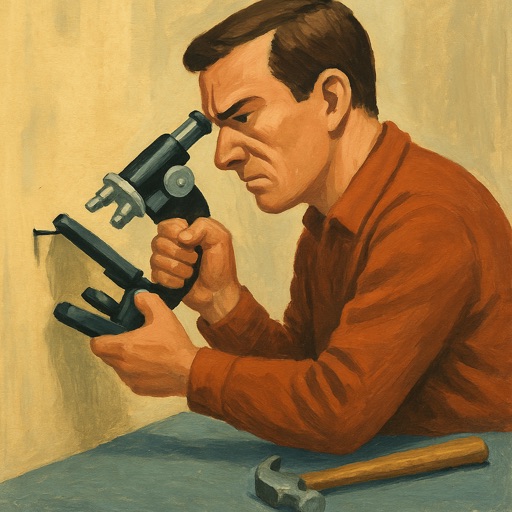

A Personal Journey from Assumptions to Awareness
✍️ By someone who used to believe the earth might be flat, until he bought a globe.
I didn’t wake up one morning with common sense. I didn’t inherit it. I didn’t find it in a fortune cookie or stumble on it during a camping trip. If I’m honest, it came slowly — awkwardly — mostly by being wrong a lot. I wasn’t raised in an environment that championed facts over feelings or reason over reaction. Like many others, I grew up echoing what was around me — family, TV, local know-it-alls — and let’s just say that “critical thinking” was not exactly part of the daily diet.
But as life had it, reality didn’t care much for my assumptions.
Stage One: The Humble Beginnings of a Head Scratcher
My early understanding of “truth” was more of a cultural remix — a playlist of half-heard opinions, schoolyard legends, and a few catchy tabloid headlines. If someone said something loud enough, or if it sounded emotionally satisfying, it was probably true. “Trust your gut,” they said — ignoring the fact that my gut had led me to believe microwaves cause cancer and that if I crossed my eyes for too long, they’d stay that way.
What I didn’t understand then is that common sense isn’t inherited — it’s built. Piece by piece. Like a messy Lego tower where you first use the wrong pieces, then take them apart and rebuild. And sometimes you step on them barefoot at 2 AM and curse your life choices.
Stage Two: Cracks in the Illusions
The first major crack in my worldview came when I tried to argue passionately about something I had read… in a comment section. Let that sink in. Someone calmly asked me for a source. I couldn’t provide one. That tiny interaction made me uncomfortable. Not because I was “owned” in the debate — but because it was the first time I really noticed that my brain had accepted a headline as holy scripture.
That’s when I began noticing patterns:
- The loudest opinions often came from the least informed.
- The most dramatic solutions to problems were often just shortcuts to disappointment.
- People I respected rarely made bold claims without backing them up.
It was then that I started seeking evidence. Not because I was suddenly a scientist — but because I was tired of being duped.
Stage Three: The Realization — Common Sense Is Work
You know what’s easier than admitting you’re wrong? Everything.
You know what’s harder than confronting your biases? Also everything.
But here’s the truth I eventually found:
Common sense isn’t a static thing. It evolves with you, and only if you let it.
To this day, I don’t consider myself wise. But I do try to be aware. I’ve learned that:
- Not all that shines is gold — and not all that sounds nice is true.
- “It sounds good” is not a fact. “It feels right” is not logic.
- Asking “why?” is the first step toward clarity — and humility.
Common sense, for me, became the ability to pause before reacting, to look for the whole picture, and to be suspicious of convenient truths. Especially when they flatter my ego or reinforce my bias.
The World Outside and the World Inside
The more I learned, the more I saw how divided people are not just by politics or belief systems, but by the ability to think critically. I don’t say this with superiority. I say it with concern.
Many are still victims of clickbait education, conspiracy spirituality, and the seductive simplicity of “us vs. them.” Theories flourish not because they’re right, but because they’re easy. Because they absolve people of the pain of doubt or the effort of understanding.
Advertising preys on this.
Pseudo-experts thrive in it.
Ideologies weaponize it.
And the people most susceptible to this illusion of truth?
- Those who never had a solid education in logic or media literacy.
- Those looking for certainty in an uncertain world.
- Those worn down by life and offered “meaning” at a discount.
- And sadly, those who’ve been conditioned to distrust nuance.
So, What Is Common Sense, Really?
To me, common sense is practical intelligence, married to humility.
It’s the willingness to say:
“I might be wrong, but I’m trying to be less wrong.”
It’s knowing that your instincts aren’t always accurate — and that trusting facts, evidence, and well-reasoned perspectives is a sign of strength, not weakness.
How to Sharpen Common Sense: My Personal Toolkit
Here are some of the practices that helped me (and still do):
- Always ask “how do I know this?”
If the answer is “I just feel it,” that’s not enough. - Separate the message from the messenger.
Even fools can say true things, and saints can lie. - Read things you disagree with — then fact-check.
Intellectual discomfort is a sign you’re growing. - Never trust anything that tells you not to question.
Whether it’s a politician, a guru, or a meme. - Admit when you’re wrong — and then research why you were.
It hurts. Do it anyway. That’s how you stretch your brain.
The Final Metaphor: The Last Breath of Learning
If life is a journey toward better thinking, then I hope my last breath isn’t taken during a nap, but while finally understanding something I got wrong my whole life.
Maybe I’ll be 97, whispering:
“Oh… that’s what they meant by inflation…”
Because that’s what common sense really is — not an endpoint, but a commitment. A refusal to surrender to intellectual laziness. A kind of quiet rebellion against ignorance, especially our own.
So if you want a better life, don’t just hope for it. Work for it. Learn for it. And yes — think for it.
Let’s stop mistaking convenience for clarity. Let’s stop selling confusion as freedom.
Let’s fight for a world where “common sense” is common again — even if it starts with just you and me.
Let’s make ignorance uncomfortable again.
And if nothing else — let’s fact-check before we forward that chain email about secret government satellites controlling the weather.
Because we’re better than that.
And common sense says — we have to be.

Author: Vlad Shapran
My life is a story about continuous education, which makes a person's life meaningful and useful.

That’s really amazing that you have drawn our attention towards a lot of uncommon human behaviors that we rarely find in modern world. Intellectual laziness can be recovered but the trouble is – a big percentage suffers from intellectual paralysis due to narcissism and lack of empathy for others. So much appreciated your personal toolkit. Interestingly, so far I have met only myself who says- “I am wrong” ha ha. So, either it’s an uncommon world full of common sense or a common world full of nonsense around us most of the time. Your article is a “must-read” to oxygenating our ‘daily breath of learning’, Vlad.
Dear Munia, thank you for your kind words and thoughtful comment. Whenever I face a problem, I always try to start by looking within. I believe that the ability to recognize our own mistakes and sincerely apologize is a true sign of both wisdom and empathy—though sadly, many still see it as a weakness. I try to approach ignorance with understanding and patience. That’s one of the reasons I’m working to grow this platform—as a space for honest dialogue about what it means to be human. But there is one thing I can never accept: the actions of those who knowingly harm others, who destroy lives and dignity for their own gain. That, to me, is inhuman—and must always be named for what it is.