
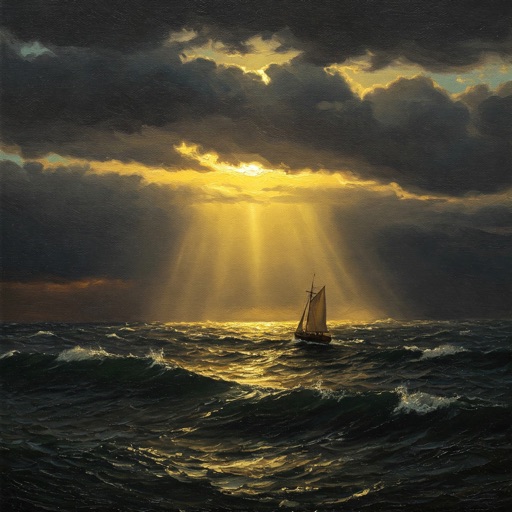

If there is no darkness
Will we miss the night?
Light has its own starkness
We need to grasp it right
A visible mass of particles of condensed vapor (mainly droplets of water or even ice) suspended in the atmosphere is
a cloud. When sunlight passes through the cloud, the cloud appears white. When the number of droplets is larger, the cloud may look gray because less sunlight passes through the cloud. When there are a very large number of droplets, the cloud appears very dark because even less sunlight reaches through the cloud—these are the dark clouds we see in the sky on a stormy day.
If the cloud is darker, the droplets are frozen, and this could be forming hail. Furthermore, less light passes through ice than through liquid water, so the cloud can get exceptionally dark. In the same way, clouds form in our life’s sky and if sunlight fails to pass through them, they get darker and darker as the droplets of misery become frozen. We should be always watchful to let the sunlight of goodness shine on life. Or else, dark clouds will keep forming.
Sometimes, another cloud blocks the sunlight by casting shadow on other clouds; we must be wary of this as well. Misery in our life comes in the form of another cloud to create an overcast situation.
Even misfortune of others can form a dark, cloudy sky for us by blocking our access to sunlight. So, we need to be exceptionally mindful of potential overcast.
However, we must not be disappointed about the dark clouds because they are always transitory, and they pass in time. We need to be patient and strong to wait for that darkness to pass away. We need to gather the sunlight from behind the miserable clouds of life if we find it so necessary.
Duke Ellington said it right: “Gray skies are just clouds passing over.”

Author: Munia Khan
Author of- “Beyond The Vernal Mind” (published 6th September, 2012) Publisher : Xlibris Corporation, USA “To Evince The Blue” (published 29th October, 2014) Publisher : Xlibris Corporation, USA “Versified” (published 23rd October, 2016) Publisher: Tiktakti Publishing Company, Tel Aviv, ISRAEL “Attainable” (Published 2nd June, 2020) Publisher: Authors Place Press, CO, USA. “Fireclay” (Published 3rd March, 2020) Rushmore Press LLC, Rainbow Boulevard, Las Vegas, USA “The Half Circle” (Published July 15, 2020) Rushmore Press LLC, Rainbow Boulevard, Las Vegas, USA "Art-Alive" (Forthcoming publication 2025) Xlibris Corporation, USA

This is beautifully written, Munia! The way you weave the scientific explanation of clouds with the metaphorical representation of life’s challenges is both insightful and deeply resonant. The imagery of sunlight as goodness and dark clouds as frozen misery truly makes the abstract feel tangible and relatable.
Thank you immensely for your valuable words of appreciation, Derek.
Expanding on this insightful piece, it’s powerful to consider how the weather, like life’s challenges, is often beyond our direct control. Just as we can’t stop a storm, we can’t always prevent ‘dark clouds’ from forming. However, your analogy beautifully highlights our capacity to navigate these times. Through knowledge – understanding the nature of these difficulties – and empathy – connecting with and supporting others facing their own storms – we gain the strength to weather any overcast situation and allow the ‘sunlight’ to eventually break through.
Your precious comment reads like an article of wisdom, dear Vlad. The upheavals of life are always there and we must continue inspiring ourselves with amazing thoughts like yours. Thank you so much for appreciating.