
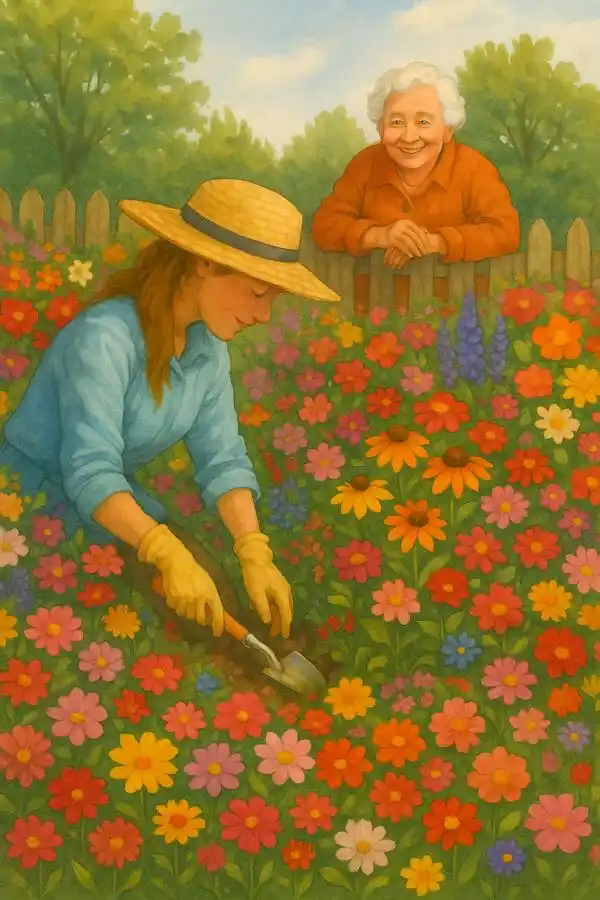

Lessons from Isobel.
Sometimes a chance meeting and conversation teaches more than any textbook. I met Isobel once, and talking with her about the simple things in life prompted me to think deeply about what it truly means to survive. Her small house on the outskirts of the city, where she cares for a riot of different flowers in a sun‑drenched garden, her role as a faithful wife and mother, her pride in two beautiful daughters, and her equally ardent devotion to those blooms speak volumes: life is a daily act of care and responsible creation.
Listening to how carefully and lovingly she tended every petal and stem, I realized that survival is more than simply drawing breath—it’s nurturing growth in ourselves and in the world around us. All living things do what they must to endure. The birds in Isobel’s yard flit from branch to branch, forever seeking shelter. We chase a raise, learn new skills, whisper promises of love—all driven by that same ancient impulse. Yet, unlike those birds, humans carry within us the powerful gift of thought. We can imagine cities of glass or worlds beyond our galaxy, but we can also spin rumors, lie, and obsess over minutiae while the planet suffocates in our ignorance and our neighbors suffer.
Our consciousness—our sense of right and wrong, our willingness to act or to turn away—is shaped by the constant stream of information we consume. Isobel reads the news with a critical eye, encourages her children to question what they hear, and always insists on checking two sources before sharing anything. Good information, she reminded me, is like water to a garden: it helps wisdom and compassion flourish. But in our rush to scroll and flip, too many of us settle for slogans that flatter our fears or headlines that pander to our prejudices.
Too often, we remain children in an adult world. We nod at catchy slogans but fail to see their complexity. We cheer “progress!” while ignoring the debts we owe to those who tilled the soil before us, and shrug when injustice blooms in plain sight. Our minds, like unkempt garden beds, are overgrown with the weeds of apathy and selfishness—for tending a garden of ideas takes time, humility, and courage.
Each of us is shaped by nature, by the stories we’ve inherited, by the kindness—or cruelty—we’ve witnessed. Our choices then ripple outward: a kind word, a small act of volunteerism, a vote; or worse, a hateful post, a closed mind, a missed election. When these ripples swell into waves of discontent or hatred, we respond—sometimes with protest and a genuine desire for change, too often with anger or resignation. “Nothing I do can change this,” we tell ourselves, and we surrender our power.
Isobel never bought into that lie. She showed me that surviving—and thriving—takes more than just the will to live. It takes the will to care, the desire to connect, and the determination to find solutions, even when they’re hard.
In our fast‑paced digital age, survival is served up in short sound bites and sensational alerts. We skim, scroll, share—or ignore entirely—rarely considering whether the next click brings us closer to truth or deeper into noise. Yet our ability to answer the call of duty is only as strong as the responsibility we instill in our hearts.
So look at your life. You have a family that protects you, a community that shapes you, and a world whose fate you share. You rely on a paycheck or a pension, on borrowed knowledge and public services. If you value survival only in terms of money or status, you risk losing the qualities that make us human: empathy, honesty, a common purpose.
Survival, then, is more than just staying alive. It is the art of living with dignity—of building connections where each person counts, where truth matters, and where the spirit of creation triumphs over the forces of destruction. If the ignorance or indifference of others threatens your future, consider Isobel’s courage: she always protects her garden from both weeds and storms. In moments of crisis, we must stand firm, and sometimes even resist with force, because unbridled cruelty kills, and indifference is its ally.
In the end, to survive means tending our common garden with intention and love, speaking out when silence would betray us, and carrying the torch of responsibility into every tomorrow. Let us not just endure, but thrive, cultivating life, justice, and beauty in a world that, like Isobel’s garden, flourishes only under a watchful, loving hand.

Author: Vlad Shapran
My life is a story about continuous education, which makes a person's life meaningful and useful.

HONRAR LA VIDA, de Eladia Blázquez
No, permenecer y transcurrir
No es perdurar, no es existir ni honrar la vida
Hay tantas maneras de no ser
Tanta conciencia sin saber adormecida
Merecer la vida no es callar y consentir
Tantas injusticias repetidas
Es una virtud, es dignidad
Y es la actitud de identidad más definida
Eso de durar y transcurrir
No nos da derecho a presumir
Porque no es lo mismo que vivir
Honrar la vida
No, permanecer y transcurrir
No siempre quiere sugerir honrar la vida
Hay tanta pequeña vanidad
En nuestra pobre humanidad enceguecida
Merecer la vida es erguirse vertical
Más allá del mal, de las caídas
Es igual que darle a la verdad
Y a nuestra propia libertad la bienvenida
Eso de durar y transcurrir
No nos da derecho a presumir
Porque no es lo mismo que vivir
Honrar la vida
Eso de durar y transcurrir
No nos da derecho a presumir
Porque no es lo mismo que vivir
Honrar la vida
The song “Honrar la vida” (“To Honor Life”) is a work by the Argentine composer and singer Eladia Blázquez (1931–2005), renowned for her significant contribution to tango and the literary quality of her lyrics, which reach great depth.
This beautiful piece of poetry expresses—with a profound sense of literary aesthetics—the difference between merely existing and living with a sense of honor and respect for life.
The phrase “permanecer y transcurrir” (“to remain and merely pass through”) refers to a passive existence, one that lacks active engagement with life and its challenges. It suggests a life without seizing opportunities, without making decisions, and without facing adversity with courage.
On the other hand, “honrar la vida” (“to honor life”) implies an active and responsible attitude toward existence, where both moments of joy and sorrow are acknowledged, and where one strives to live according to values such as truth, freedom, and dignity. It is an invitation to live with purpose, to make conscious decisions, and to seek deeper meaning in every experience.
In summary, “not to merely remain and pass through” describes a passive and aimless way of living, whereas “to honor life” means living actively, with purpose and responsibility—making thoughtful choices and finding deeper meaning in each moment.
From my perspective, the song also conveys a powerful message about the importance of living fully, with dignity and commitment—beyond mere existence.
Lastly, I would like to share a gift with you: one of the most beautiful musical interpretations of this poem, performed by Guillermina Beccar—an Argentine singer devoted to setting meaningful lyrics to music https://www.youtube.com/watch?v=fSa7fnzKe9M&list=RDfSa7fnzKe9M&start_radio=1
These are some of the values promoted by #HumanityUnion.
Dear Juan, this is not a comment, it is a great addition to my thoughts. I am very impressed, especially after listening to the song of this wonderful poem. I am very grateful to you for fresh solutions, in the form of links to the diversity of the comment, because our platform is also the popularization of different cultures, revealing the harmony of humanity.
Excellent application from a new member of our Union! Welcome, dear Juan! Such people and such poems give us strength to resist ignorance.
Gracias Michael por tu amable bienvenida. Espero estar a la altura y honrar tus palabras.