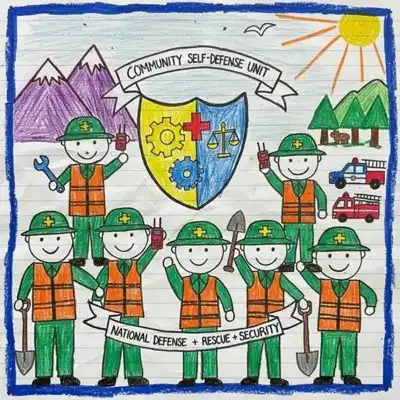

Modern security challenges no longer fit neat categories: climate disasters, hybrid warfare, disinformation campaigns, and rapid-onset humanitarian crises move across borders and overwhelm single agencies. In this context, a Community Self-Defense Units (CSDU) – organized, trained, and legally sanctioned – offers a practical, community-centered layer of protection that complements professional armed forces and emergency services. Properly designed, such units strengthen rapid local response, preserve essential services, protect vulnerable populations, and deter exploitation of civic disorder, while remaining non-militarized and bound by law, human rights, and transparent oversight. This publication outlines why establishing public self-defense units is a necessary adaptation to twenty-first-century threats, and invites informed discussion on governance, training, and safeguards to ensure civic resilience without compromising democratic values.
What are CSDUs?
Community Self-Defense Units (CSDUs) are locally organized, civilian volunteer teams established to strengthen community resilience, provide immediate humanitarian assistance, and support official emergency and civil-protection services. CSDUs are a permanent, non-militarized civic structure that will form the grassroots layer of the future World Protection Corps (WPC) while operating under clear national authority today.
CSDUs are not a substitute for professional armed forces, police, or emergency services. They are trained, organized, accountable volunteers whose primary purpose is to protect lives, preserve essential services, and assist professional responders in crises.
Why CSDUs are needed
- Faster local response. In many crises the first minutes and hours determine outcomes. Trained local volunteers provide immediate assistance before professional teams arrive.
- Stronger community resilience. Regular training and civic engagement build social trust and preparedness.
- Humanitarian focus. CSDUs concentrate on protecting civilians — evacuations, sheltering, medical first aid, logistics — not combat.
- Integration with broader protection systems. As part of a national and future WPC framework, CSDUs create predictable, interoperable local capacity aligned with international standards and law.
Core principles
- Civilian, voluntary, and non-partisan. Membership is open to motivated adults; units operate free from partisan activity.
- Non-militarized. No firearms. Only non-lethal, authorized defensive equipment may be issued under strict legal controls and only in exceptional, clearly defined situations.
- Legal and accountable. Units operate under national law, with formal oversight, reporting, and independent review mechanisms.
- Integrated and coordinated. CSDUs work in liaison with police, civil protection, health services, and (where applicable) WPC structures.
- Rights-respecting. All activity follows human rights, humanitarian law, and ethical conduct.
- Transparent. Public reporting, community oversight, and open communication are required.
Typical CSDU responsibilities (non-exhaustive)
- Immediate first aid and casualty support until medical teams arrive.
- Assisting evacuations, shelter setup, and basic logistics for displaced persons and refugees.
- Protecting and monitoring critical civilian infrastructure in a non-confrontational role (e.g., presence, reporting, access control assistance).
- Escorting life-saving shipments and vulnerable individuals under official coordination.
- Community alerting, situational reporting and liaison with emergency command.
- Public preparedness education, drills, and local resilience activities.
Organizational model
- Local Unit: Town, city district, or village level. Volunteer membership, small elected/appointed leadership council, functional squads (medical, logistics, communications, shelter).
- Municipal/Regional Coordination: Local units registered with municipal civil protection; regional offices link units to emergency services and national WPC liaison.
- National Integration: Ministries or agencies responsible for civil protection provide legal status, training oversight, and funding support. A designated national WPC office (or equivalent liaison) ensures compatibility with WPC standards and the Humanity Protection Command Center guidance.
- WPC Role: When constituted, the WPC provides standard training curricula, interoperability protocols, and ethical/legal frameworks; CSDUs remain local civilian teams connected to this global system.
Training & standards
- Core curriculum: First aid (including CPR), basic search-and-rescue, crowd management and safety, communications and reporting, humanitarian ethics, and legal responsibilities.
- Specialized modules: Shelter management, logistics handling, disability assistance, psychological first aid, and information integrity (countering disinformation).
- Exercises: Regular local drills with emergency services; periodic regional exercises to test interoperability and command protocols.
- Certification: Members and leaders receive identifiable certification and re-certification to maintain standards.
Equipment
- Permitted (standard): High-visibility vests, basic first-aid kits, stretchers, radios/communication devices, protective helmets, flashlights, and shelter supplies.
- Authorized defensive equipment (exceptional): Non-lethal items (e.g., protective shields, tracked non-lethal devices) may be issued only under explicit legal authorization, strict inventory controls, and supervisor oversight. Firearms are prohibited.
- Safety first: All equipment use follows written rules, training requirements, and incident reporting.
Legal status, oversight and safeguards
- Legal mandate. Governments adopt enabling legislation or administrative orders that define the CSDU role, limits, and accountability.
- Oversight bodies. Municipal authorities and national civil protection agencies provide operational oversight; independent review panels and human-rights observers periodically audit CSDU activity.
- Code of conduct. Mandatory for all members: impartiality, protection of human dignity, prohibition on partisan action, non-discrimination, and a duty to report misconduct.
- Complaints and redress. Public complaint mechanisms and rapid suspension/removal procedures are established to address violations.
How to join (summary)
Register your interest by completing the Preliminary Expression of Interest Form (preliminary anonymous/pseudonymous expressions of interest may be accepted; confirmation is required prior to operational deployment).
Upon legislative approval of the CSDU, all applicants will be provided with additional guidance on the subsequent steps:
- Complete background checks and basic health screening.
- Attend core training and pass certification.
- Take the CSDU oath and receive identification and insignia.
- Participate in regular drills and continuing education.
Frequently asked questions (brief)
Q: Will CSDUs become armed militias?
A: No. CSDUs are civilian and non-militarized. Firearms are strictly prohibited. Any use of defensive equipment follows tight legal controls.
Q: Who commands CSDUs during emergencies?
A: Local incident commanders from official emergency services direct operations; CSDUs act under liaison protocols and national coordination where applicable.
Q: Are volunteers liable for actions during operations?
A: Volunteers work under a legal framework that includes liability protections for authorized, good-faith acts. Specific provisions are defined by national law.
Q: Can CSDUs be deployed outside their community?
A: Mutual aid is possible under formal agreements and with the consent of responsible authorities; all deployments follow legal and oversight arrangements.
Closing statement
Community Self-Defense Units are a way for citizens to transform care for neighbors into concrete, lawful capability. Properly structured, trained, and supervised, CSDUs expand the ability of communities to save lives, sustain essential services, and preserve democratic norms in times of crisis. They are local expressions of a global commitment: protection of human life, dignity, and the rule of law.

Author: Vlad Shapran
My life is a story about continuous education, which makes a person's life meaningful and useful.