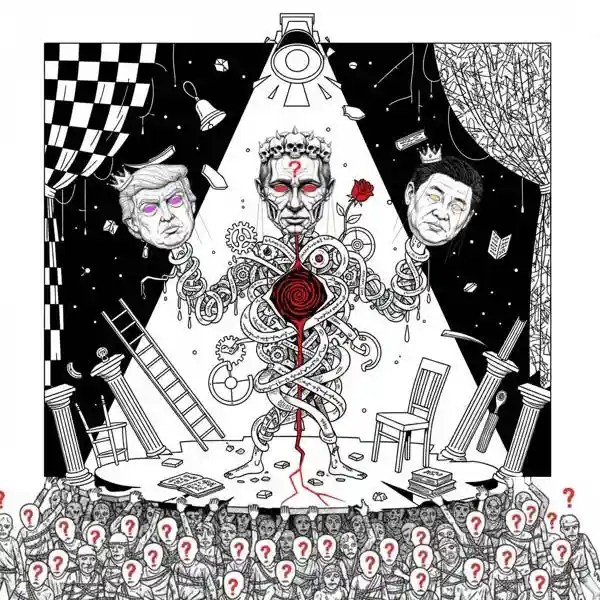

The Theater of the Absurd and the Price of Global Ignorance.
How many times must the same experiment be run before the outcome is accepted as fact? How many wars, crushed protests, broken treaties, and televised lies must pass before societies admit that the pattern is not accidental? We live in an age where consequences are no longer debated; they are documented. Yet denial persists. This is not confusion. It is global ignorance operating at scale.
The present moment resembles a theater of the absurd. The stage is crowded with loud declarations, performative diplomacy, and ritual expressions of “concern.” Behind the curtain, rules are dismantled, violence is normalized, and human dignity is treated as expendable. The audience watches, some applaud, others look away, and many convince themselves that nothing can be done. That collective posture is the danger.
The primary danger markers
Three danger markers define the current trajectory of global affairs. Each is well known. Each has been tolerated. Together, they form a system of self-destruction.
1. The destruction of rules, treaties, and international law
International law exists to restrain force, not to decorate speeches. When treaties are violated without consequence, law becomes optional and power becomes absolute. Aggression is no longer an anomaly; it becomes a tool.
 The invasion of Ukraine did not emerge from a vacuum. It followed years of tolerated violations, ignored warnings, and strategic blindness. Once the principle of territorial integrity is treated as negotiable, every border becomes provisional. Every small state becomes expendable. Lawlessness at the top cascades downward, and violence becomes contagious.
2. Populism and elite irresponsibility
Populism thrives where responsibility is abandoned. It elevates those who promise simplicity in a complex world and rewards those who reject expertise, accountability, and restraint. Citizens are encouraged to feel rather than to think, to resent rather than to understand.
 Donald J. Trump did not invent this phenomenon, but he embodied it on a global stage. By attacking institutions, dismissing facts, and normalizing political theater over governance, he contributed to the erosion of democratic discipline. The damage was not confined to one country. When the United States weakens its own institutional credibility, the entire international order feels the shock.
Populism is not merely a failure of leaders. It is a failure of citizens and elites who tolerate incompetence and cruelty as long as it serves short-term interests or emotional satisfaction.
3. Destructive information and the normalization of hatred
Falsehood is no longer a byproduct of politics; it is an industry. Propaganda, conspiracy theories, and selective outrage are deployed to divide societies and justify repression. Violence is reframed as defense. Aggression is marketed as necessity.
When entire populations are trained to distrust facts and dehumanize opponents, atrocities become easier to commit and harder to stop. This is how hatred based on nationality, culture, race, or ideology is laundered into public policy.
The theater and its leading roles
The theater of the absurd has recognizable actors.
 Vladimir Putin occupies the role of principal aggressor. His decision to wage war against Ukraine represents a direct assault on the post-war international order. This is not a regional dispute; it is a declaration that force overrides law.
 Aleksandr Lukashenko demonstrated how internal repression complements external aggression. By crushing the Belarusian people’s demand for justice in 2020, his regime reinforced the lesson that power, once unchecked, will always turn inward before turning outward.
But the theater does not function without enablers, observers, and hedgers.
China presents itself as neutral while benefiting from instability and resisting unified enforcement of international norms. Strategic ambiguity may appear sophisticated, but its cumulative effect is permissiveness toward aggression.
India balances principles against interests, often choosing abstention where clarity is required. Such positioning weakens collective deterrence and signals that violations can be managed rather than confronted.
Qatar plays mediator, a role that can be constructive. Yet mediation without accountability risks becoming a mechanism for delay, allowing aggressors time to consolidate gains.
Saudi Arabia oscillates between condemnation and accommodation. Ambivalence from influential states does not stabilize the system; it erodes it.
None of these actors operate in isolation. Together, they form an environment in which aggression is observed, analyzed, debated, and ultimately absorbed rather than stopped.
Iran and Venezuela: the cost of indifference
Global ignorance is most visible where hope is repeatedly crushed.
 In Iran, citizens have risked their lives to demand dignity, freedom, and basic rights. Their courage has been met with repression, surveillance, and violence. The world responds with statements, then returns to business.
 In Venezuela, years of misrule and repression have hollowed out a society. Protest has been met with force, and suffering has become normalized. International attention spikes briefly, then fades.
These cases expose the moral failure of selective concern. When support for justice depends on convenience, justice becomes meaningless.
Consequences we can no longer deny
The consequences of these danger markers are not hypothetical.
- International law loses authority, replaced by transactional power politics.
- Democratic institutions decay under constant assault and public cynicism.
- Repression becomes routine, and resistance becomes isolated.
- Hatred is legitimized, and violence is rationalized.
- Future conflicts become more likely, not less.
History shows where this leads. Elites who believe they can manage chaos eventually become its victims. Anti-people forces never stop at one target. They consume societies and then turn on each other.
How to confront global ignorance
This trajectory is not inevitable. It is sustained by choices, and it can be altered by choices.
Short-term actions
- Find and unite with like-minded individuals and organizations. Isolation is a gift to aggressors.
- Participate in media projects in any capacity: writing, editing, translating, supporting, commenting. Truth requires distribution.
- Support governments, institutions, and civic actors that invest resources in resisting aggression and disinformation.
- Take initiative. Small, consistent actions accumulate into pressure.
Long-term responsibilities
- Invest in social and civic education. Societies that cannot distinguish truth from performance are easily manipulated.
- Teach historical responsibility, including the failures of the 20th century, without selective memory.
- Strengthen institutions that enforce law rather than merely discuss it.
- Demand accountability from political and economic elites who profit from instability.
Conclusion: the choice before us
Severe trials lie ahead. They are not the result of fate but of neglect. After the Second World War, the world failed to fully confront all architects of mass violence, and that failure echoes today. Justice delayed became ignorance inherited.
Future generations will not judge us by our declarations, but by the systems we defended or allowed to collapse. The theater of the absurd will continue as long as the audience mistakes spectacle for inevitability.
Global ignorance is not an excuse. It is a condition we choose to maintain or to dismantle.
The question is no longer whether the danger markers are visible. The question is whether we will act before the next act begins.

Author: Michael Kaplan
To encourage people to think, understand, and find solutions in the fight against ignorance, while promoting knowledge and inspiring personal and collective responsibility for a more enlightened and just society.