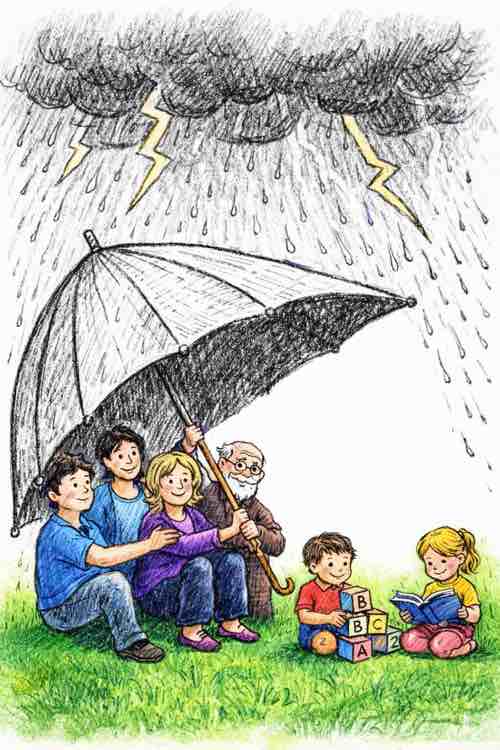

I love myself — and I fear for my life. That admission is honest, human, and universal. Today, the question of security — of protecting the individual, the home, and the state — occupies center stage. Humanity faces a stark challenge: will international law and human security hold firm in every corner of the globe, or will naked force and cynical manipulation prevail?
Across many societies we see a dangerous pattern: corrupted power and short-term opportunism replace law and principle. Political actors and irresponsible influencers trade integrity for advantage; citizens who surrender convictions for convenience create fertile ground for aggression, corruption, and contempt for human dignity. Conflicts flare and natural systems are sabotaged, yet the loudest voices often belong to provocateurs, willful deniers, and those indifferent to the human cost. They spin ambiguity into sympathy for aggressors, weaponize distorted facts, and cultivate fear as license.
Fear, in turn, drives people to shelter behind slogans and rationalizations. That impulse is understandable — survival instincts are powerful — but it does not merit approval. Survival without principle yields hollow safety: a fragile, short-lived shelter that collapses when the next crisis arrives. Real, resilient security depends on a different set of choices — choices rooted in law, in shared responsibility, and in preparation.
 The security of every person is inseparable from the rule of law. When institutions are professional, transparent, and accountable, individual protection follows; when institutions are politicized or corrupt, protection becomes conditional and precarious. That is why the task of responsible citizens, of accountable governments, and of honest media is to connect personal safety with public duty: protecting oneself is not an act of coercion or punishment — it is an exercise in collective survival.
Practical preparedness matters. Armies require modern equipment, training, and leadership. But the same logic applies to civic defense: with even modest, well-structured training, citizens can substantially reduce vulnerability to military aggression, information warfare, and terrorist violence. Universal vigilance — not as paranoia, but as civic competence — enables communities to resist manipulation, to sustain essential services during crises, and to shield fragile institutions from being looted or corrupted.
Awareness, clarity of purpose, and coordinated action are the pillars of effective human security. When citizens know their roles and institutions operate with integrity, society stands resilient against both kinetic and informational threats. The goal is not militarization of everyday life but the creation of robust systems that protect life, uphold rights, and ensure that emergency responses are timely, lawful, and humane.
That conviction underpins the Humanity Union’s initiative to establish a unified protective institution — the World Protection Corps (WPC). The WPC is proposed as a global, professional capacity designed to prevent the roots of large-scale conflict and environmental sabotage, to coordinate rapid rescue and medical response, and to defend the civil and ecological foundations of our shared world. Crucially, this force is conceived to be independent of partisan swings and authoritarian capture: its mandate is the protection of people, not the preservation of political advantage.
This idea is an invitation to responsibility. It appeals to those who accept that safeguarding the present secures the future: parents, civic leaders, professionals, and ordinary citizens who refuse to outsource their survival to corrupt politics or to the whims of populism. Each person — through participation, advocacy, training, or simply by voting — can help build a dependable bulwark for human life and rights.
Practical contributions matter. Volunteer training programs, civic preparedness curricula, transparent funding and oversight, and international legal safeguards are concrete ways individuals and organizations can empower the WPC concept. If formed with democratic accountability and ethical clarity, such a corps could become a reliable instrument of protection that meets contemporary standards in human rights and environmental stewardship.
Do not miss the chance to be involved. Our security begins with ourselves: with our choices, our readiness, and our refusal to accept manipulation as normal. If you care about your life and the lives of those who follow, contribute to creating institutions that defend life, dignity, and the rule of law. Our future depends on what we do now — not on the comforts of denial, but on the courage of preparation.
 Defend our children’s rights

Author: Vlad Shapran
My life is a story about continuous education, which makes a person's life meaningful and useful.