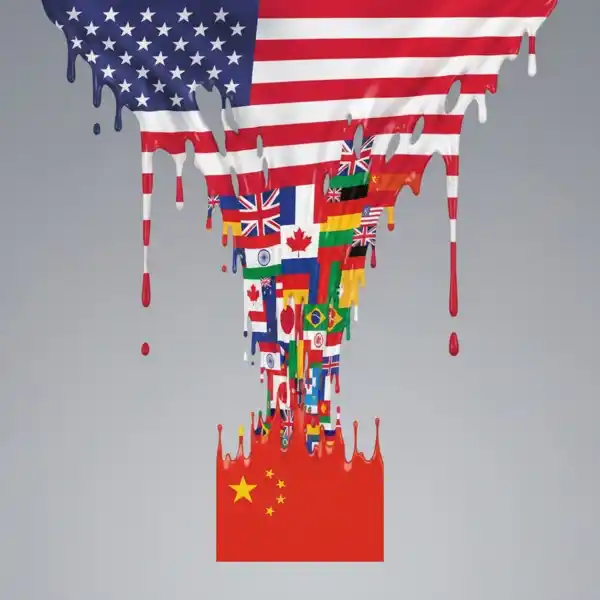

How retreating American leadership, opportunist autocrats, and our own indifference invite a darker world.
Something important has been lost—not a single law or treaty, but a habit: the habit of public responsibility and steady leadership that made a rules-based world possible. After two apocalyptic world wars the United States helped build institutions that tethered great power rivalry to law and cooperation: the United Nations, the Marshall Plan that rebuilt and anchored democratic Europe, and NATO’s collective defense that deterred expansionist aggression. These were imperfect instruments of national interest and moral purpose, but they worked because the country that stood behind them often accepted the costs of leadership. ООН+2history.stte.gov+2

Today that steady center is wobbling. The consequence is not merely rhetorical. It is practical: where leadership withdraws, vacancy invites predators. Vladimir Putin’s full-scale assault on Ukraine in 2022 smashed the fragile post-Cold-War assumption that borders are sacrosanct. The U.N. General Assembly’s overwhelming condemnation made clear that the world still remembers the rules; but the response also revealed how enforcement frays when power politics returns. The invasion exposed a grim truth: norms matter only as long as someone is willing to pay the price of upholding them. press.un.org
If you want a blunt, on-the-record example of abdication, look at the pattern of U.S. withdrawals from multinational commitments in recent years. The United States pulled out of the Trans-Pacific Partnership and then the Iran nuclear accord; more recently it has once again announced withdrawal from the Paris climate pact, signaling a political posture that prizes short-term spectacle over long-term stewardship. These moves do not occur in a vacuum: they weaken alliances, inspire second-guessing among friends, and encourage rivals to press their advantage. United States Trade Representative+2Reuters+2
 Blame is not a metaphysical exercise. The collapse in credible, consistent U.S. leadership is a political choice. The administration that prizes populist spectacle, transactional deals, and the theatrics of grievance over the boring work of governance has created predictable gaps. Call it incompetence, call it cynical politics—either way it is destructive. When policy is driven by immediate headlines rather than institutions, allies lose faith, adversaries test limits, and the scaffolding of international law becomes a convenient target.
Who fills the vacuum? China and a cohort of authoritarian regimes.  Beijing’s Belt and Road Initiative offers infrastructure, loans and diplomatic cover to capitals eager for projects and ready cash. Where Washington once offered security and a vision—however imperfect—China now offers concrete inducements that can bind leaders into spheres of influence. Scholars, international institutions and independent analysts have documented how BRI projects have translated into leverage, raised debt sustainability questions, and sometimes enabled corruption and elite capture in partner countries. That leverage is geopolitical: infrastructure becomes influence, and influence is used to blunt criticism in multilateral forums. Council on Foreign Relations+1
 Put bluntly: a world where great powers treat international law as optional is a world in which ordinary people pay with liberty. Authoritarian states do not merely seize territory; they normalize the erosion of civic institutions, the capture of courts, and the co-optation of media. Those are not exotic phenomena happening in distant countries alone; they are contagious practices exported through money, technology, and example.
But geopolitics alone is not the full story. The other half is us. Citizens who retreat into cynicism, who prefer distraction to civic education, who reward spectacle on social platforms, and who tolerate the trivialization of truth are co-conspirators in this slide. Media outlets that prioritize clicks over verification, opinion over reporting, and outrage over context amplify demagoguery. Every retweet that dehumanizes an opponent, every shrug at a courthouse packing, every rationalization of venal behavior—even when “both sides do it” provides moral cover—erodes the civic muscle democracy needs to resist authoritarian pressure.
This is why shame matters. Not for shaming’s own sake, but as a corrective. Shame can be the visceral spark that moves comfortable indifference to public action: vote, demand accountability from institutions, support independent journalism, and insist that leaders honor long-term obligations even when they are costly. The institutions we built after the wars—treaties, alliances, and multinational economic frameworks—are not antiques; they are tools. They require care.
The moral geometry of the last century is instructive: American power, with all of its contradictions, helped create conditions where free institutions could survive and flourish in many parts of the world. The Marshall Plan rebuilt Europe’s economies and anchor-ed them to democratic politics; NATO tied deterrence to collective treaty obligations; U.N. mechanisms provided forums to hold aggressors to account. Those were the practical means by which freedom was nurtured. Abandoning them slowly erases their protective benefit. history.state.gov+2nato.int+2
 The choice confronting us is stark: recommit to the messy, costly business of democratic governance, international cooperation, and the defense of norms—or acquiesce to a world that substitutes stability for dignity, order for liberty. If we choose the latter, we can expect more wars of revision, more clientelism, more barter of sovereignty for short-term gain, and the quiet normalizing of coercion.
This is not coded partisan rhetoric. It is a civic alarm. Those who lead have a duty to defend common goods; those who follow must refuse the easy comforts of distraction. We should feel some shame for what we have let slide—then channel it into repair. Organize the chambers, petitions, deliberations and education campaigns that rebuild civic muscles. Demand accountability. Insist that leadership be measured not by tweets but by the willingness to bear cost for principle.
If we do not, the question “From freedom to slavery?” will stop sounding rhetorical. It will read like a description of our children’s world.

Author: Vlad Shapran
My life is a story about continuous education, which makes a person's life meaningful and useful.