
Peace is not the absence of war, but the presence of justice. — Martin Luther King Jr.
After the second world war the civilized world set itself a noble course: educate a generation of pacifists, build institutions to prevent the recurrence of mass slaughter, and make diplomacy and law the first recourse of nations. For a time that path offered hope — a blueprint for universal peace and collective security. But hope alone was never enough. We did not foresee, or chose not to notice, one quiet consequence: in many societies we cultivated defensive reactions to violence rather than practical methods to remove it at its roots.
Defensive reflexes are not the same as prevention. Teach people to fear and to duck, and over time you teach them to accept strikes as inevitable. Teach them instead how to disarm hatred, how to resolve grievances before they harden into violence, and the result is a different civilization. We made mistakes on every side, and the great ideological contests of the twentieth century learned quickly how to exploit those mistakes. The machinery of fear proved a ready tool for those who wanted power without responsibility.
We must admit a painful truth: the higher some rise on the social ladder, the less tethered they become to ordinary humanity. “Power tends to corrupt, and absolute power corrupts absolutely,” Lord Acton observed. It is a truism because it is a pattern. When power becomes an end in itself, influence becomes the ultimate resource — more sought after than oil, more coveted than territory. Today’s wars often conceal that truth: they are as much about prestige and leverage as about land or raw materials. Power itself is a commodity, and the scramble for it corrodes the moral imagination.
If we are to confront the modern threats to peace, we must begin by naming them plainly: rampant individualism that isolates citizens from each other; lack of reliable information that leaves publics blind and gullible; social illiteracy that erodes civic virtues; an erosion of empathy that lets others be counted as less than human; a slavish mentality that prizes obedience above conscience; and an unsettling adaptability that trains people to survive under oppression rather than resist it. These are the slow, internal wars that feed outward violence.
Consider the role of education. There is a promising model called Social Education,  but too often our schools and institutions teach compliance more readily than judgment. When schooling becomes an instrument of rote production rather than a workshop for moral and civic imagination, we raise efficient technicians, not responsible citizens. We instruct minds to perform, not to question. In many quarters, fear of responsibility becomes the curriculum’s silent sponsor: people devise every excuse to avoid discomfort, every rationale to preserve comfort, rather than the hard apprenticeship of acting for the common good.
Economic pressure amplifies these tendencies. Individualism is not only an idea; it is a social arrangement born of inequality and dependency. When survival depends on a paycheck from a factory that pollutes, who among us will risk protest for the sake of distant future harms? If your family eats because you clock in and run a machine that degrades the environment, the moral calculus becomes agonizingly narrow. If you are a police officer and orders from above secure your job and your household’s welfare, the choice between conscience and obedience is not theoretical — it is material. These are not abstract dilemmas; they are daily, lived ones, and they explain much about why societies sometimes drift from tolerance to repression.
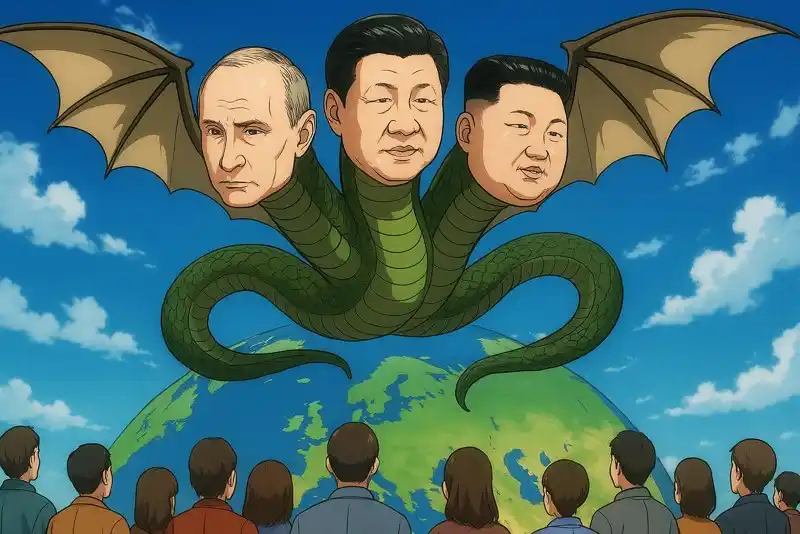
What grows in the shadow of these failures is the figure of the dictator. Mental wretchedness, a poverty of thought and empathy, becomes fertile ground for leaders who promise simple answers, scapegoats, and securitized comfort. Authoritarianism is not an unexpected accident; it is the cultivated outcome of social ignorance. Where education is weak, where public life is atomized, where empathy has withered, authoritarian figures appear as relief: decisive, commanding, convenient. But convenience is a dangerous currency — it buys temporary order by mortgaging liberty and human dignity.
I am not calling for revolution. I am calling for a deeper rationality, guided by humanity. Step by step, we must think more carefully and more courageously than ever before because our world sits at a turning point in the awareness of values. If a society tolerates authoritarianism, not by force but by neglect, it is not merely allowing a political model to take hold; it is allowing an anti-human infection to spread — an infection that enfeebles moral imagination, normalizes cruelty, and makes empathy anachronistic.
We have played for too long with leaders and celebrities as if they were toys; we have cultivated a culture that mistakes spectacle for authority. The worst part of that game is not who wins, but that we do not see the social catastrophe approaching, signed in our own ignorance. Only collective decisions — made in public, debated in daylight, and sustained by institutional integrity — can protect humanity from degradation.
Knowledge and openness are not soft comforts; they are defensive technologies. Honest information inoculates a society against manipulation. Social literacy — the ability to read institutions, to understand incentives, to imagine consequences — builds resistance to demagogy. Empathy is a defense, not a weakness: it prevents the dehumanization that makes violence possible.
If peace is to be more than the temporary absence of war, it must be rooted in justice, education, and an ethic of responsibility. The remedy is not mystical. It is communal, rational, practical. It is the slow work of teaching citizens how to think, how to listen, how to refuse the easy lie in favor of difficult truth. It is the patient building of structures that reward transparency and penalize predatory power. It is the insistence that influence be exercised with accountability, and that leadership be measured in service rather than spectacle.
We stand at a crossroads — and the choice is clear: summon minds, not munitions; insist on the courage to reason together, not blind obedience. The threats before us are real, and prudence demands institutions that protect people and deter violence. One promising proposal — conceived to act beyond any single government or interest bloc — is the Humanity Union’s initiative to create the World Protection Corps (WPC):  a truly global security framework designed to prevent conflicts, save lives, and safeguard our common future. This is not a call for centralized domination, but for accountable, collective capacity to intervene when diplomacy fails and to shore up peace before violence takes hold. If peace means anything, it is the daily practice of justice; it is an educated, empathic public that sees through slogans, resists the allure of domination, and refuses the easy inheritance of cruelty.
Join with others in groups and unions whose mission is to serve humanity and to protect it from threats. Share knowledge, cultivate empathy, and insist that power answer to moral standards. The task is not small. But neither is the cost of inaction. Let us be the generation that learned to think — and thus, finally, learned to keep the peace.
Organizations and Associations
whose stated missions include serving humanity and protecting people:
- United Nations (UN)
- European Union (EU)
- North Atlantic Treaty Organization (NATO)
- World Health Organization (WHO)
- International Committee of the Red Cross (ICRC)
- UN High Commissioner for Refugees (UNHCR)
- Médecins Sans Frontières / Doctors Without Borders (MSF)
- Amnesty International
- Human Rights Watch (HRW)
- International Rescue Committee (IRC)

Author: Vlad Shapran
My life is a story about continuous education, which makes a person's life meaningful and useful.