
The U.S. military intervention in Venezuela a few days ago will have immediate knock-on effects for American national security—both positive and negative. On the positive side, a ruthless dictator is now behind bars. That’s a good thing for anyone who cares about democracy and human rights, as most Americans do. Second, the flawless execution of this difficult and dangerous mission demonstrated the tremendous capabilities of the U.S. armed forces and intelligence agencies not only to Caracas, but to the entire world. That will help shape the actions of Maduro government officials still in Venezuela, while simultaneously enhancing American deterrence in other regions of the world. Lastly, the arrest of Nicolas Maduro—whom the U.S. charged with drug-trafficking and other criminal actions — might now positively disrupt the flow of cocaine into the United States, although that remains still a hope, not a given.
At the same time, this military intervention produced immediate costs to American national interests. Most damagingly, Trump’s unilateral decision to launch this military attack without approval from any multilateral organization further erodes the already significantly damaged rule-based international system that has served America so well since its creation after World War II. This military intervention was not an act of self-defense—Venezuela posed no imminent danger to American national security— and therefore was a violation of the UN Charter. It is not the first time that American presidents have ignored international law, but two wrongs do not make a right. Doing so now gives Russian leader Vladimir Putin fresh talking points for why his unilateral intervention in Ukraine—also without the UN’s blessing—was done allegedly in the name of Russian national interests (as defined by him, of course). If Chinese leader Xi Jinping ever decides to invade Taiwan, you can bet that Chinese propagandists will invoke this example of American unilateral intervention as an excuse to justify Beijing’s own actions. Second, if the U.S. “running” of Venezuela (as Trump has promised) drags on like the “running” of Iraq and Afghanistan did, then the United States will once again be devoting attention and resources to a peripheral threat when we should be focused on the primary challenges to American national security, which emanate from autocratic China and Russia. Third, as demonstrated by the near-unanimous condemnation from Democrats of Trump’s military action without Congressional approval, Trump’s move has fueled increased polarization within the United States. When we are fighting among ourselves, we are not focused on the real threats to American national security posed by China and Russia.
Long-term evaluations of the success or failure of the U.S. military intervention in Venezuela, however, will be determined by what happens next. If Trump and his administration now successfully facilitate a transition to democracy in Venezuela, the military operation will be remembered as a fantastic achievement. If Trump and his team do not focus on helping to restore democracy but instead work with the remnants of the Maduro regime still in power to gain access to Venezuela’s oil, the military operation will be remembered as a grotesque return to 19th-century colonialism and 20th-century interventionism.
Today, it is not clear which path Trump prefers, but he seems to be leaning towards the latter. That Trump proclivity must be reversed before it’s too late.
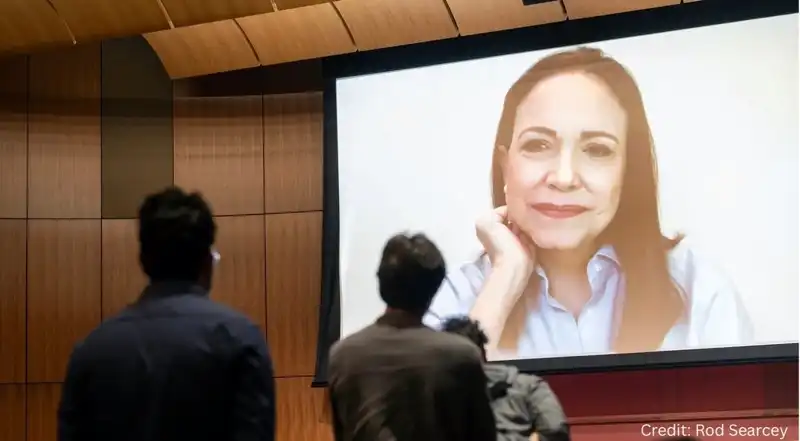
Most alarmingly, in his first press conference after the military operation, Trump mentioned oil a dozen times but did not utter the word democracy once. When asked whether he would support Maria Corina Machado, the leader of Venezuela’s democratic opposition and recent winner of the Nobel Peace Prize, Trump threw her under the bus. He claimed inaccurately that “she doesn’t have the support within or the respect within the country.” Trump alarmingly speculated that “it would be very tough for her to be the leader” of Venezuela. Instead, he reported that Secretary of State Marco Rubio had been talking to Maduro’s vice president, Delcy Rodriguez, who he said was “willing to do what we think is necessary to make Venezuela great again.” Trump implied that if Rodriguez did what Washington wanted her to do, she and the government would remain in power. And judging by what he said at the press conference, we can assume that what Trump wants her to do is to give American companies ownership or access to Venezuelan oil. He made no mention of his desire for Rodriguez to cooperate with Venezuela’s democratic opposition to negotiate a peaceful path to restoring democracy.
If Trump does not prioritize democracy in Venezuela right now, that would be a giant lost opportunity because the conditions for a successful democratic transition there are so ripe. The collapse of authoritarian regimes rarely leads smoothly to the emergence of new democratic regimes (e.g., the French, Bolshevik, Chinese, or Iranian revolutions, or, more recently, the dissolution of dictatorships in the Soviet Union or Yugoslavia). By contrast, Venezuela today has many unique attributes that can facilitate a smooth transition to democracy.
Most importantly, is the fact that the 2024 Venezuelan presidential election was won not by Maduro, but by democratic opposition leader Edmundo González Urrutia. We know this because a sophisticated parallel-vote tabulation (PVT) based on the counting of ballots at the precinct level—probably the most successful PVT ever executed anywhere ever— revealed conclusively that Gonzalez won this election by a thirty-point margin. Restoring democracy in Venezuela, therefore, is simple—let Gonzales be sworn in as president. Venezuelans must run Venezuela, not Secretary Rubio or Secretary Pete Hegseth, as Trump suggested in his press conference. At a minimum, Gonzalez could serve as interim-president until new free and fair elections could be organized.
Second, Venezuela has a history of democratic governance. They will not be starting from scratch. Comparative studies of democratization show clearly that “re-democratization” is much easier than inventing democratic institutions and norms for the first time.
A third facilitating factor for democracy is the Venezuelan opposition’s unity. Divisions with democratic movements— especially between those based inside countries versus those living in exile—often make democratic transitions messy. That will not be the case in Venezuela. Moreover, Venezuela’s democratic movement has many strong, charismatic leaders, not just one. Machado is the unquestioned leader today but others, including the former mayor of the Chacao district of Caracas, Leopoldo Lopez, and the former mayor of Al Hatillo, David Smolansky, will help to fill out a new government.
Third, Venezuelan society is not divided by ethnic, religious, or separatist movements that often complicate or even undermine democratic transitions, as witnessed in Afghanistan, Iraq, Libya, and Syria. Armed criminal gangs and officials from the Maduro regime who are still in power will complicate democratic consolidation in Venezuela, but these challenges are not insurmountable. With careful diplomacy, many in the armed forces and police can be co-opted.
Fourth, a democratic transition will attract back to Venezuela many of the most talented individuals who fled Maduro’s regime. This influx of immigrants back into the country will catalyze economic growth.
Fifth, Maduro destroyed the once-flourishing Venezuelan economy. A new democratic government headed by Gonzalez and Machado will introduce market reforms that will spark new economic growth. Research has shown that economic growth after a transition from authoritarian rule is the most essential attribute for consolidating democracy.
Finally, and relatedly, Venezuela’s commitment to markets and capitalism will attract new foreign investment into Venezuelan oil companies, which, in turn, will spur economic development. Privatization will be a key element of their strategy. And this is why Trump should focus on democracy now and oil later. The United States cannot just take Venezuela’s oil. That is morally wrong. Americans will not support it, nor will Venezuelans. But a successful transition to democracy will create the permissive conditions for American energy companies to invest in Venezuela. Machado and her team have made clear their commitment to offering lucrative incentives to American companies to participate in Venezuela’s energy sector. By supporting democratic restoration now, Trump and his business associates will gain access to the oil he seems to covet. Win-win!


Author: Michael McFaul
Michael McFaul is the Ken Olivier and Angela Nomellini Professor of International Studies in Political Science, Senior Fellow at the Freeman Spogli Institute for International Studies, and the Peter and Helen Bing Senior Fellow at the Hoover Institution, all at Stanford University. He joined the Stanford faculty in 1995 and has served as FSI Director from 2015 to 2025. He is also an international affairs analyst for NBC News. McFaul served for five years in the Obama administration, first as Special Assistant to the President and Senior Director for Russian and Eurasian Affairs at the National Security Council at the White House (2009-2012), and then as U.S. Ambassador to the Russian Federation (2012-2014). He was also the Distinguished Mingde Faculty Fellow at the Stanford Center at Peking University in the summer of 2015. McFaul has authored and co-authored several books, including, most recently, Autocrats vs. Democrats: China, Russia, America, and the New Global Disorder. His previous book, “From Cold War to Hot Peace: An American Ambassador in Putin’s Russia,” was a New York Times bestseller. His current research interests include great power relations between China, Russia, and the United States, the relationship between democracy and development, and American foreign policy....